La coïncidence est bien curieuse. A moins de deux semaines du sommet de l’Union africaine (UA) qui se tiendra, sauf changement, à la fin de ce mois de janvier 2011 à Addis-Abeba (Ethiopie) et dont l’un des sujets centraux constitue la crise post électorale en Côte d’Ivoire, la France de Nicolas Sarkozy a illico presto annulé la dette du Malawi à son égard évaluée à environ 10,8 millions d’euros (environ 7,182 milliards de fcfa). Selon le quotidien malawite, Nyasa Times, du mercredi 12 janvier dernier, qui a livré cette information, l’ambassadeur de France au Malawi, Jacques Gascuel, a soutenu que cet argent permettra au Malawi de dresser la carte géographique du pays en faveur de l’industrie minière. Au-delà du discours officiel, le décryptage attentif de ce geste soudain de la France envers le Malawi permet de comprendre qu’il pourrait s’agir ni plus ni moins d’une action de Sarkozy liée au combat que mène la France contre la Côte d’Ivoire pour écarter le Président Laurent Gbagbo du pouvoir et imposer Alassane Ouattara, l’homme de la nébuleuse, aux Ivoiriens en toute illégalité. Paris tente donc de corrompre le Malawi dont le chef de l’Etat, Bingu Wa Matharika, est également président en exercice de l’UA. En réduisant la dette du Malawi, Nicolas Sarkozy veut ainsi appâter Bingu Wa Matharika afin que celui use de tout
son «poids» au sommet d’Addis- Abeba pour aider la France à «dégommer» Gbagbo du pouvoir. Pour que son poulain Ouattara, dont nul n’ignore qu’il a largement fraudé lors du second tour de la présidentielle, s’installe à la tête de la Côte d’Ivoire en violation de la Constitution ivoirienne.
La France de Sarkozy perçoit en Bingu Wa Mutharika, un allié important pour accomplir cette «mission» d’autant, selon une dépêche de l’agence de presse Apa datée du 5 janvier dernier, le chef de l’Etat malawite avait déjà embouché la trompette gaulloise en soutenant, dans un communiqué, que «Ouattara a remporté l’élection présidentielle en Côte d’Ivoire». Paris veut à la fois, sans doute, récompenser le Malawite pour ce coup de pousse et l’encourager à achever sa «mission» quasiment moutonnière. D’où cette réduction de la dette.
Photos of Ivory Coast and Sudan: Visual Codes, Affirming Narratives
For western eyes, Sudan has most often appeared as a site of famine or war, be it in the south or Darfur. Said to be “one of the hollow-bellied places of the world” or a landscape “seared by war,” the continent’s largest country has often been rendered via stereotypical images.
The politics of the situation facing Sudan is inevitably complex (the International Crisis Group has excellent analyses of the situation here and Alex de Waal has his usual profound insights here). So how can it be visualized? How can politics be represented in pictures?
This week we have seen two conventional strategies in response to that challenge. The first is to invoke images from the past…
The second is to record the appearance of the visible traces of politics, namely leaders engaged in ceremonies where the trappings of sovereignty are evident. Peter Martell’spictures of President Omar al-Bashir’s visit to the south earlier this week are an example of this, showing Bashir’s welcome by the south’s leader Salva Kiir, with the requisite red carpet, military officials and marching band.
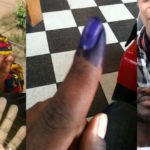
It is a lot to ask of a single photograph that it represent the complexities of politics, no matter how talented the photographer. No doubt in the week ahead we will see pictures of polling stations, queues of voters, and people raising inky fingers to signify the completion of their electoral act (hopefully images of conflict will be absent). Who, though, will produce something a little different?
This is what David Campell has to say about the visual representations of the referendum in Sudan. The last paragraph is especially poignant and I think it’s important to try and imagine what a photograph that captured these complexities would look like. A group of South Sudanese in heated debate, perhaps with political posters on a wall behind them framing their engaged expressions? A voter leaving a polling station with a look of dismay, confusion, or trepidation on his or her face, rather than the stock happy voter images we’re seeing over and over? I’m not that either of these theoretical images, or any image for that matter, might do the trick. Perhaps this isn’t the kind of complexity that can be captured through spot news photography.
In Ivory Coast, an equally complicated political situation is being widely photographed. In yesterday’s New York Times, a story about civilians paying the price for political tumult is accompanied by two photographs by different photographers of dead bodies.


The question is what each photograph tells us about the politics of the situation, and the answer, I fear, is very little.
I strongly believe this has far more to do with the demands of newspaper photography and news imagery than any shortcoming on the part of the photographers. Both snappers are well established image makers who have worked in West Africa for many years and undoubtedly know far more about the politics involved than either of these images lets on.
In an interview, Stephen Mayes, managing director of VII, says:
Rather than looking at oneself, and at one’s own experience, what photojournalism has become is the process of looking at others in a way that is intrinsically remote and idealized. Representations of war, for instance, fall into standardized forms. There are certain [visual] codes that recur. What I tend to find is that so much journalism we see is about affirming what we already know, instead of challenging us to broaden our horizons.
The photographs coming out of Sudan and Ivory Coast at the moment mainly reflect instances of these known visual codes. This is partially because they are all news photographs, which are constrained by factors like time, budget, and logistics, and partially it’s because this is what newspapers think that readers want. They are documents of the situation, verification of what’s happening and when, rather than explanations or commentary.
The numbers of comments on Chris Blattman or Jina Moore’s blog that delve into the details and nuances of just what is going on in Ivory Coast clearly point to the fact that not all readers want simple narratives, and I would argue this could extend to a desire for photographs that are more than known visual codes as well.
Readers, what do you think? Do these types of photos do the trick when it comes to illustrating what’s going on? Or do you want to see something else? Also, can anyone point to examples of images that illustrate politics, in Africa or elsewhere, more effectively than these do?
Here’s one of my favorite images by Ami Vitale of a rally in Kashmir that manages to be both political and metaphorical, and through its use of metaphor demands that I as a viewer challenge my assumptions and seek to learn more about what’s happening.
Cote d’ivoire: Le budget 2011 de l’Etat ivoirien adopté par le gouvernement ce jeudi
Le Conseil des ministres se tient ce jeudi, au palais présidentiel, en présence du président Laurent Gbagbo, au cours duquel le budget 2011 de l’Etat sera adopté.
Mardi, à l’issue du conseil de gouvernement, son porte-parole, Ahoua Don Mello, ministre de de l’Equipement et de l’Assainissement, a indiqué que les membres du gouvernement, sous l’autorité du premier ministre, Aké N’Gbo, ont examiné ce budget qui sera constitué, au regard de la situation politique du pays, des ressources propres du pays.
Proclamé élu chef de l’Etat par le Conseil constitutionnel, la communauté internationale et les institutions financières internationales disent ne pas le reconnaître, mais bien Alassane Ouattara, candidat du Rassemblement des houphouétistes pour la démocratie et la paix (RHDP), déclaré vainqueur du second tour de l’élection présidentielle par la Commission électorale indépendante (CEI) et certifié par le Représentant spécial de l’ONU. A ce titre, elles ont suspendu leur soutien au fonctionnement de l’Etat, notamment dans les investissements des infrastructures socio-économiques nécessaires pour la relance de l’économie du pays éprouvée par une dizaine d’années de crise militaro-politique.
Outre le budget, la situation « insurrectionnelle » à Abobo où il a été institué, mercredi, un couvre-feu de trois jours, pourrait également débattue par le Conseil des ministres, a dit le ministre Ahoua Don Mello.
S: AIP
Des émissaires de Ouattara en Angola
Jean Marie Kacou Gervais et Bakayoko Hamed étaient en mission pour M. Allassane Ouattara le mardi dernier en Angola où ils ont été reçus par le vice-président angolais, Fernando da Piedade Dias DOS Santos et le ministre des affaires étrangères George Rebelo Chicoty.
Selon M. Jean Marie Kacou Gervais, le chef de délégation, ils étaient porteurs d’un message de M. Ouattara et avaient été délégués pour s’instruire de l’expérience angolaise pour la recherche d’une solution pacifique à la crise postélectorale en Côte d’Ivoire.
Les deux émissaires ivoiriens ont par ailleurs salué les efforts du président angolais Dos Santos dans sa quête perpétuelle de solutions pacifiques dans les crises politiques en Afrique.
Pour le message retour, le ministre des Affaires étrangères angolais leur a répondu «Nous avons vécu la guerre durant des années en Angola. Pour cela, nous ne pouvons pas pousser la Côte d’Ivoire à une guerre».
Michel Drucker condamné par la cour d’appel de Paris à verser 40.000 euros à Calixthe Beyala
L’animateur vedette de la télévision française Michel Drucker a été condamné par la cour d’appel de Paris à verser 40.000 euros à Calixthe Beyala, pour n’avoir pas rémunéré l’écrivaine qui en 2006 avait écrit un livre à sa place.
En juin 2005, un contrat de commande d’ouvrage avait été conclu entre Michel Drucker, 69 ans, et les éditions Albin Michel, pour un livre d’entretiens où le présentateur de télévision devait répondre aux questions de l’intellectuel Régis Debray. Un projet avait été rédigé mais l’ouvrage n’avait finalement pas été publié.
L’écrivaine française d’origine camerounaise affirme avoir rédigé les réponses aux douze questions de Régis Debray, mais n’avoir jamais reçu les 200.000 euros qu’il lui avait promis.
En juin 2009, Mme Beyala avait été déboutée. Plus encore, le tribunal de grande instance de Paris l’avait condamnée à payer un euro à Michel Drucker pour procédure abusive.
La cour d’appel a adopté une autre analyse. Elle a estimé que Calixthe Beyala avait bien « oeuvré à la composition du manuscrit », en répondant aux 12 questions posées et qu’elle était par conséquent « fondée (…) à se prévaloir de l’exécution d’une prestation au profit » de Michel Drucker.
La cour d’appel a également reconnu que la « relation intime établie depuis plus de deux années » entre Mme Beyala et M. Drucker justifiait que Calixthe Beyala se soit trouvée « dans l’impossibilité morale » d’exiger un contrat établissant sa rémunération. M. Drucker devra verser à Mme Beyala 30.000 euros de dommages et intérêts, ainsi que 10.000 euros de frais d’avocat.
AFP (lesoir.be)
Alassane Ouattara’s emissaries in Angola
The Angolan vice president, Fernando da Piedade Dias dos Santos, received on Tuesday in audience in Luanda, two emissaries of the candidate to the presidential elections in Cote D’Ivoire, Alassane Ouattara.
The emissaries are Jean Marie Kacou Gervais (head of the mission and Bakayoko Hamed.
The audience was granted in the ambit of the continuation of Angolan efforts, in order to seek for a peaceful and negotiated solution to the post election crisis in Cote d’Ivoire.
On the occasion, the head of the delegation Jean Marie Kacou Gervais recognises the important role played by the Angolan President, José Eduardo dos Santos, seeking for solutions in political crises within Africa.
According to him, his delegation is in Angola in order to learn about the Angolan experience.
The meeting was attended by the Angolan foreign affairs minister, George Rebelo Chicoty.